How to Set Boundaries With Friends Without Guilt
35% off on product page · save $6.99
How to Set Boundaries With Friends Without Guilt

Why boundaries belong in healthy friendships
A boundary describes what you need or what you will do; it is not a rule for controlling another person. “I won’t answer messages after 9 p.m.” sets a limit on your availability. Demanding that a friend never send a message after 9 p.m. attempts to control their behavior.
You may still feel guilty when you make a reasonable request, especially if you are used to putting others first. Guilt is a feeling worth noticing, but it does not automatically mean you have done something wrong.
Pay attention to recurring resentment, exhaustion, or pressure. These feelings can be prompts to ask yourself where you need more choice or a little more room. For more context on caring for relationships, explore the American Psychological Association’s relationships resources.
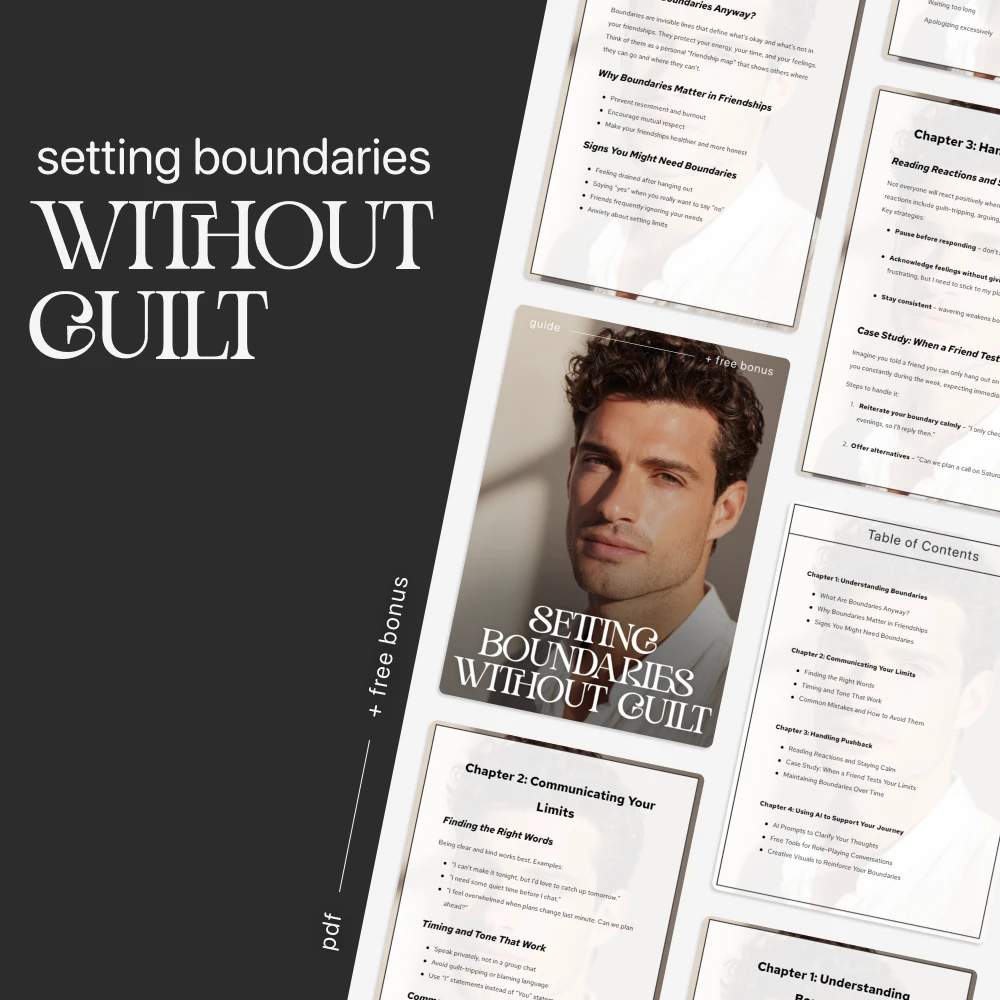
Featured in this guide
Setting Boundaries Without Guilt | Guide on how to set boundaries with friends, Friendship Communication, Self-Respect Digital Download
Find the boundary you need
Name the situation, its impact, and one change you can make. For example: “When plans change at the last minute, I feel rushed. I can say no when I don’t have enough notice.”
Choose a limit you can communicate and follow through on, even if your friend would prefer a different answer. Boundaries can also cover emotional capacity and money; they do not have to be dramatic to matter.
Everyday friendship boundaries
- Late-night messages: “I switch off at night, so I’ll reply tomorrow.”
- Last-minute plans: “I can’t make it today. I’d love to plan ahead next time.”
- Money: “I’m not able to lend money.”
- Privacy: “Please check with me before sharing that.”
- Emotional capacity: “I care about you, but I can’t talk about this tonight.”
Physical space counts, too. You might say, “I’m not comfortable hugging today, but I’m happy to see you.” You do not need to offer an alternative if you do not want to.
Say it clearly and kindly
Name the situation, state your limit, and offer an alternative only if it feels genuine: “I can’t talk for an hour tonight. I have ten minutes now, or we can catch up this weekend.”
You can be warm without providing a lengthy defense. If you need time to decide, try, “Let me check my schedule and get back to you.” Your friend may feel disappointed; you can listen respectfully without withdrawing your boundary.
When a friend pushes back
Rather than debating your limit, calmly repeat it: “I hear that you’d like me to stay on the phone, but I need to go at eight.” If the call continues, you might say, “I’m going to hang up now. We can talk another day,” and then end it.
Look at patterns rather than labeling someone after one crossed boundary. Does your friend listen when you clarify, or do they repeatedly pressure you? If you feel unsafe, prioritize your safety and reach out to someone you trust for support.
Check the product’s listed specifications when evaluating when a friend pushes back.

Watch · product page video
“This digital download was so helpful in teaching me how to have difficult conversations about personal space with my friends. Now, we all feel respected and heard”
Allurete product page · Product review
Keep practicing self-respect
Choose one small boundary to try this week. Afterward, notice how it felt to express it and what happened when you followed through. You can adjust the wording or timing as you learn, without abandoning the need behind it.
Making time for yourself can also mean choosing an activity you enjoy. If baking is one of yours, our Non-Stick Silicone Cake Turntable Baking Mat is an option for your kitchen. Whether you spend that time baking or resting, you can decide how much of it to share.
Check the product’s listed specifications when evaluating keep practicing self-respect.
FAQ
How can I set boundaries without being mean?
State what you need in clear, respectful language. You can allow your friend to have feelings about your limit without taking responsibility for managing those feelings.
What kind of person ignores boundaries?
Many factors can contribute to someone crossing a boundary, so a label is less useful than noticing repeated behavior. Consider whether the person respects your limits after you clarify them, and prioritize your safety.
What are the 3 C’s of boundary setting?
A clear boundary names the behavior or situation you’re addressing and what you will do, rather than expecting someone to guess how you feel. For example, you might tell a friend, “I’m not available for calls during work, but I can talk this evening.”
See if Setting Boundaries Without Guilt | Guide on how to set boundaries with friends, Friendship Communication, Self-Respect Digital Download fits your setup













Leave a comment